
Bilawal Bhutto's political inheritance is his biggest asset as well as the biggest liability as he tries to make his mark in Pakistan politics. Challenging the Taliban militants is part of that strategy, though it matches with his political ideology. Shahzad Raza profiles the son of Benazir Bhutto and Asif Ali Zardari.

'If you invest your entire capital in talks, you cannot abruptly change gear and decide on war.'

'Bhutto feared elements of the so-called establishment, including people linked to the intelligence services. She highly distrusted individuals like Hamid Gul who -- she was convinced -- maintained active ties with jihadists.' Heraldo Munoz, author of the sensational new book, Getting Away With Murder, tells Rediff.com's Vicky Nanjappa in an exclusive interview.

'The ISI has given a stunning display of its capacity to do with impunity what it likes within Kabul. Incensed over the triumphalism of the hardliners in Kabul, the ISI has hit out; it is a typical ISI reflex action that Indians are familiar with,' says Ambassador M K Bhadrakumar.
'We think Pakistan has moved decisively against terrorists that threaten Pakistan internally, but still needs to devote attention to those that represent a threat to their neighbours.'

India questioned the functioning of Pakistan's notorious military courts.

Any settlement with Pakistan won't last unless it comes with big power guarantees, says Shekhar Gupta.
'India should be more confident and let Pakistanis meet Hurriyat leaders. India's main concern is terrorism, and India should talk terrorism. If that means talking Kashmir, so be it. India can't answer terror with terror because we don't have terror factories. India can't answer terrorism with war because we both have nuclear weapons. That leaves talks as the only option,' says Shivam Vij.

'Pakistan needs to be constantly at war with somebody, ultimately resulting in it waging war on itself and its own people,' says Shekhar Gupta.

'This is a US-India effort and it is not necessarily to counterweight anyone.'

'What we are today witnessing is the final act of the Pakistani army trying to retain its turf,' argues Colonel Anil A Athale (retd).

Top 20 images of all the events of the week that was.
'Just this week, the Indians killed a Kashmiri terrorist, who is a member of Hizbul Mujahideen.' 'This is a nasty terrorist organisation, and did Pakistan welcome this killing?' 'No, in fact, they denounced it and referred to him as a Kashmiri separatist.' 'These Kashmiri terrorist groups have been aided by the Pakistani State.'

'The Pakistan government, we were told, has a plan to renovate several Hindu temples and Buddhist sites, which over the years have fallen into disrepair. The aim is to create a pilgrimage circuit to attract visitors from all over the subcontinent.'

'ISI mouthpieces in the media have been quick to blame India for the attack. Clearly, the intellect and worldview of these characters (which includes fairly senior retired military officers) is based on Bollywood movies like Ek Tha Tiger and Agent Vinod... More seriously, the fact that ISI touts have been using this opportunity to train their guns on India raises serious questions about all the talk of the army being on the same page as the civilian government on the issue of improving relations with India,' says Sushant Sareen.

'All this talk of 'tactical nuclear weapons' or a limited nuclear war are 'false flags'! It looks like India and Pakistan are slowly but surely inching towards this realism,' says Colonel Anil A Athale (retd).

'Despite almost $30 billion of funding since 2001, all the US reaps today is unmitigated hostility of a Pakistan emboldened to flaunt its China card.' 'How can the US give credence to any offers from Pakistan, which has trotted out the standard alibi of non-State actors time and again, including dreaded terror outfits being out of State control, Pakistan itself being a victim and so forth?'

'Against the backdrop of difficult administrative, political and economic problems, Imran's temperament and staying power will be the subject of intense expectation and public scrutiny,' says Rana Banerji, who headed the Pakistan Desk at the Research and Analysis Wing, India's external intelligence agency.
'As long as Pakistan exists, the situation will not stabilise and violence is bound to erupt from time to time.' 'Though not a final solution, a step that could help localise the abscess -- trifurcate Jammu and Kashmir state into three parts: Jammu, Ladakh and the Valley.'
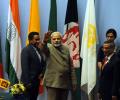
'If his three priorities are the economy, the economy, the economy, then there is need for a stable region, a stable neighbourhood.'
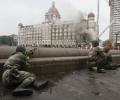
Through its early days to the 1980s, Pakistan sought to expand its sphere of Islamic influence through Afghanistan to Central Asia and got Pakistani citizens recruited in the Afghan government institutions in the 1990s when the Taliban were power. Now, it is looking eastward through India to Bangladesh and Myanmar to establish an imaginary caliphate.

United States Special Representative for Afghanistan and Pakistan James Dobbins, who was in New Delhi on Thursday said in an interaction with the press that improvement in Indo-Pak ties will automatically improve the situation in Afghanistan, even as he discussed the current state of play in US-Afghan relations and attempts to work towards reconciliation with top officials.

'For so long as the rulers of Pakistan remain committed to confronting and vanquishing India, they will sustain delusions, breed terrorists, and export them.'

'While military acts such as the Uri surgical strikes are one option, cultural, economic and diplomatic isolation should also be part of the arsenal,' argues Sankrant Sanu.

'One lesson to emerge out of the Modi-Putin summit is that India can be more self-confident that it possesses inherent strengths to leverage its interlocutors to influence Pakistani policies,' says Ambassador M K Bhadrakumar.

WWhat Pakistan faces in the Tehrik-e-Taliban Pakistan is virulent insurgency and terrorism, fuelled by its association with Al Qaeda
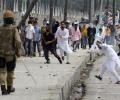
Kashmiris hope that India and Pakistan can find a lasting solution to what many call the Kashmir 'problem'.

From early indications, the Modi government's foreign policy seems to be pragmatic and reciprocal, says K G Suresh.

Rediff.com reproduces this 2014 interview with Tim Kaine where in he discusses the new opportunities to foster Indo-US trade and the improvement in ties.

Those who know Shiv Shankar Menon will vouch that he did lots of things, substantial in the immediate neighbourhood and widespread in South Asia, but without making things public. Twenty per cent of Menon's job was visible, while 80 per cemt of his job was not known to the public, says Sheela Bhatt/Rediff.com
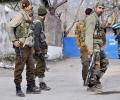
'It would be very easy for me to say, it's only the Pakistanis that want the Kashmir issue to remain alive.' 'Trust me, there is a vested interest on the Indian side in keeping the issue of Jammu and Kashmir alive.'

The India that needs strategic alliances, defence cooperation and engaging meaningfully with neighbouring countries is quietly moving ahead with confidence, says Tarun Vijay

'We have a common way of looking at the world, a common way of thinking, and a common set of values that predispose us to be partners. And our interests overlap greatly,' Dr Ashton B Carter, America's next defence secretary, told Aziz Haniffa/Rediff.com in an exclusive interview.

'The US-India relationship is in a different league altogether,' Obama administration officials tell Aziz Haniffa/Rediff.com in Washington, DC.

'We are encouraged by what the prime minister said recently on these issues... We will keep a close eye on these issues. They are very important and as are other elements of our human rights and religious freedom.' 'So, absolutely, we'll keep a focus on them.'

Do Modi's foreign visits actually serve India or they nothing more than expensive tools for domestic positioning and image-building, asks Shehzad Poonawalla.

'The Senators were playing safe, not angering either the pro-India lobby or the pro-Pakistan lobby, but perhaps more importantly, the military-industrial complex -- the most powerful lobby of all -- which the majority of Senators are beholden to in terms of largesse to their campaign coffers.'

'We are completely engaged in fighting poverty; alas, our neighbour Pakistan seems only engaged in fighting us.'

A lot of the terrorism that is affecting Pakistan is really a blowback of the Pakistani state's policy of using jihadist groups as instruments of state policy. And unlike some other countries with similar policies, Pakistan doesn't have the benefit of the political and social space for pulling back from the disastrous course, says Sushant Sareen.

'If Indian armed forces entered Pakistan and succeeded in inflicting major damage on the Pakistani army and occupied territory in the Pakistani heartland, there is reason to think the Pakistani military would use some nuclear weapons against the incoming Indian forces to compel India to stop.'
 © 2026 Rediff.com - Advertise with us - Disclaimer - Privacy Policy - Sitemap - Feedback - About us - Terms of use - Grievances